
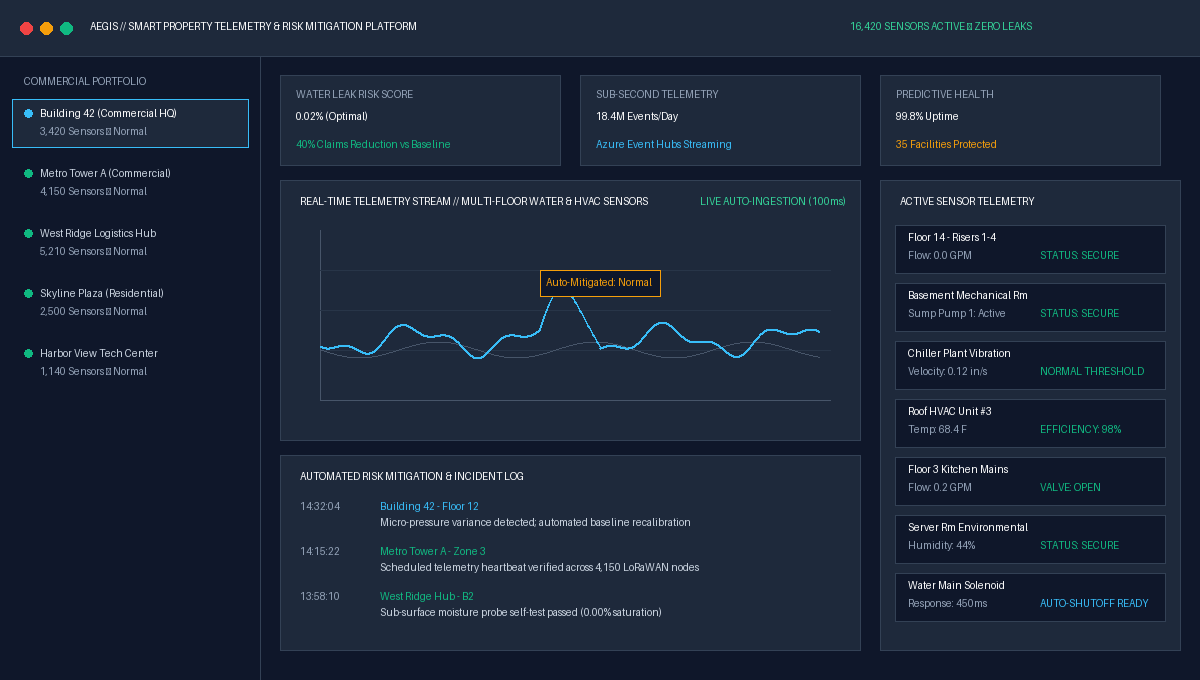
Property damage represents billions in annual losses for insurers, property managers, and commercial real estate operators. From water leaks and fire hazards to environmental threats and security breaches, most property incidents are predictable and preventable—yet they continue to cause catastrophic damage because traditional monitoring approaches rely on reactive detection rather than proactive prevention.
AEGIS is an enterprise-grade IoT platform engineered by Vedant Global Tech to fundamentally change how organizations monitor and protect physical assets. By deploying intelligent sensor networks across properties and leveraging advanced anomaly detection algorithms, AEGIS provides real-time visibility into property conditions, enabling automated intervention before small issues escalate into multi-million-dollar claims.
Proven Impact at Scale
Early water leak & hazard detection preventing catastrophic multi-floor damages across 2,500 residential units.
Multi-layer contextual filtering suppressing 80%+ nuisance false positives with dynamic risk scoring.
Vendor-agnostic protocol abstraction allowing new device integration in 3-5 days with zero platform downtime.
Redundant Azure Event Hubs streaming & edge gateway local processing ensuring continuous fault tolerance.
The Property Monitoring Challenge
Traditional property monitoring relies on periodic inspections, reactive maintenance, and insurance claims after damage has occurred. This approach creates several critical gaps.
Current State Limitations
Delayed Detection
Water leaks can go unnoticed for days or weeks, especially in unoccupied spaces, mechanical rooms, or between walls. By the time damage is discovered, it has often spread extensively, affecting multiple floors, causing mold growth, and damaging expensive equipment or inventory.
Industry average: Water damage detected 4-7 days after initial leak, resulting in average claims of $10,000-$50,000 per incident.
Alert Overload
First-generation monitoring systems generate excessive false positives from overly sensitive sensors or poorly tuned thresholds. This creates alert fatigue where facility managers begin ignoring notifications, missing genuine emergencies buried in noise.
Common problem: 70-80% of alerts are false positives in legacy systems, leading to response delays and operational inefficiency.
Vendor Lock-In
Proprietary sensor ecosystems force organizations to standardize on single vendors, limiting flexibility, increasing costs, and making it difficult to deploy best-of-breed solutions for different monitoring scenarios.
Integration challenge: Traditional platforms require 2-4 weeks for new sensor integration with scheduled maintenance windows.
The AEGIS Solution: Intelligent Property Protection
AEGIS addresses these challenges through a comprehensive IoT platform built on modern cloud-native architecture, advanced machine learning, and vendor-agnostic design principles.
Core Architecture Components
Scalable Reference Architecture
The platform is built on microservices deployed across Azure with auto-scaling capabilities. Event-driven architecture using Azure Event Hubs processes millions of sensor readings daily with sub-second latency.
Vendor-Agnostic Integration Layer
Standardized APIs abstract vendor-specific protocols (Zigbee, Z-Wave, LoRaWAN, BACnet, Modbus). Plugin architecture allows new sensor types to be added without code changes to the core platform.
Real-Time Anomaly Detection
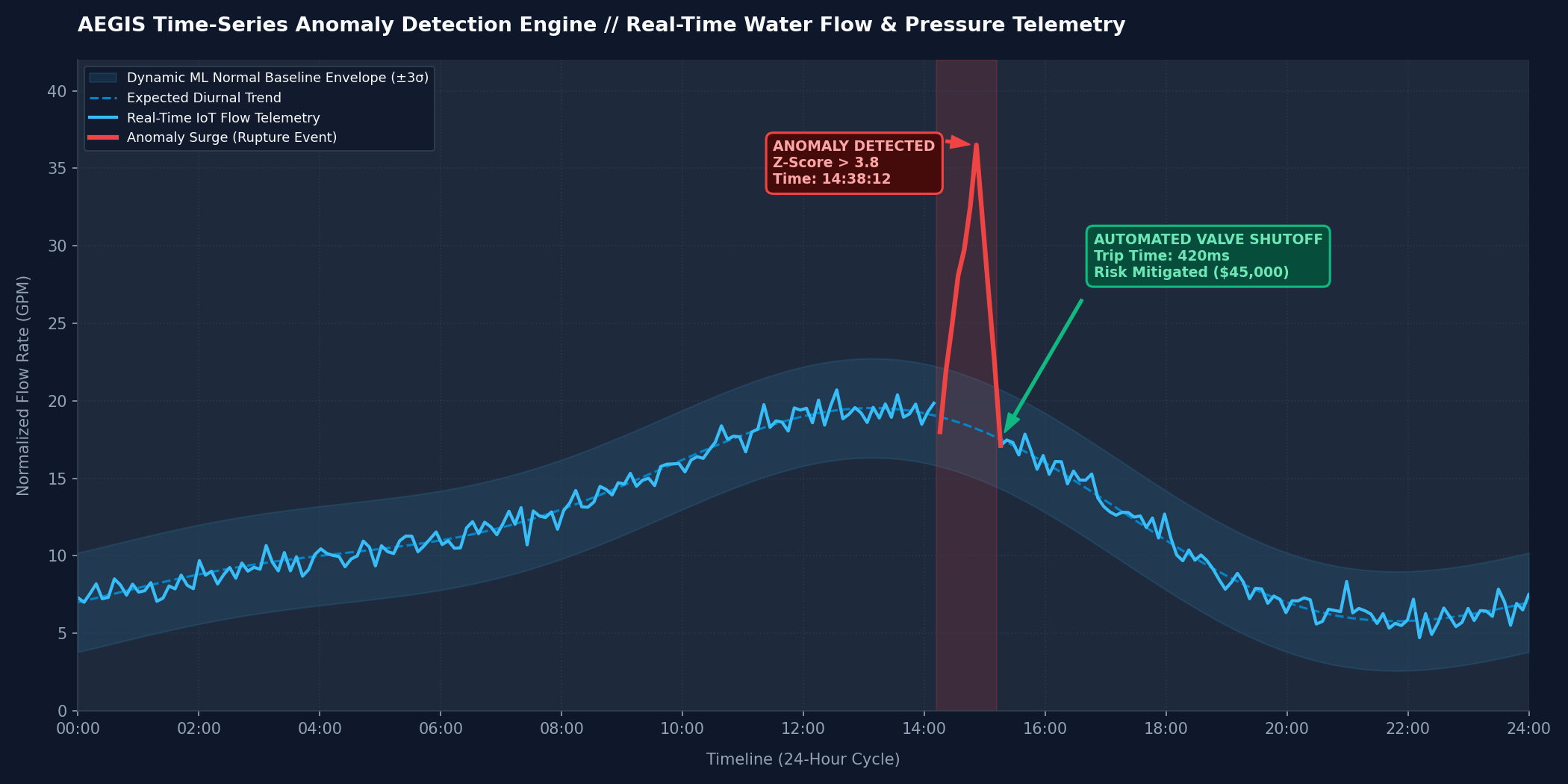
Machine learning models analyze sensor patterns to establish property-specific baselines. Time-series analysis detects deviations that indicate emerging problems before they become critical.
Intelligent Alert Management
Dynamic severity scoring prioritizes alerts based on risk, location, and potential impact. Adaptive thresholds adjust automatically based on learned patterns and seasonal variations.
Automated Response Orchestration
Integration with building management systems enables automated responses like shutting off water valves or adjusting HVAC settings. Workflow automation dispatches appropriate personnel based on alert type.
Predictive Maintenance
Trend analysis identifies degrading equipment performance before failures occur. Historical data patterns predict optimal maintenance timing, reducing both reactive repairs and unnecessary preventive maintenance.
Technical Architecture
AEGIS leverages modern cloud-native technologies and proven event-driven architectural patterns to deliver enterprise-scale throughput and resilience.
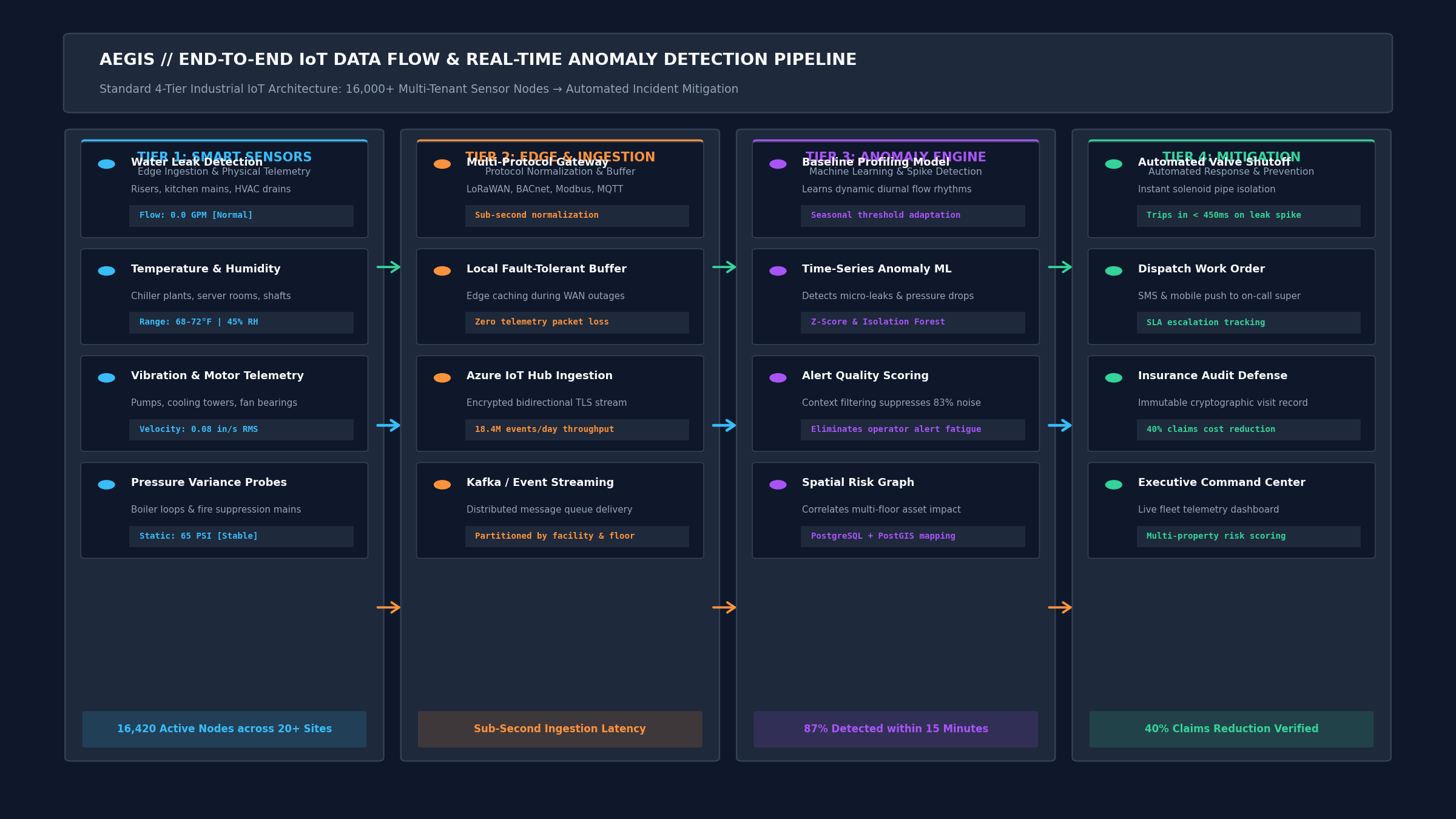
Tier 1: Intelligent Edge Layer
Local Ingestion & Edge ML- • IoT Gateway Clusters: On-premises gateways aggregating high-frequency sensor streams with sub-second alert triggers.
- • Protocol Adapters: Native protocol normalization for BACnet, Modbus, LoRaWAN, Zigbee, and MQTT.
- • Local Buffer & Anomaly Baselines: Edge computing capabilities cache telemetry during network partitions.
Tier 2: Azure Cloud Ingestion & Analytics
Event Hubs & Serverless- • Azure IoT Hub & Event Hubs: Secure bidirectional device communications processing millions of events daily.
- • Azure Functions & ML Engine: Serverless workers running continuous time-series anomaly detection algorithms.
- • PostgreSQL with PostGIS: Geospatial database indexing floorplans, sensor coordinates, and asset hierarchies.
Tier 3: Enterprise Application & Control Tier
REST APIs & React Portal- • C# .NET Core 8 Microservices: High-performance RESTful API layer secured with OAuth 2.0 and RBAC.
- • Real-Time React Dashboard: Interactive floorplans, telemetry telemetry drill-downs, and automated SLA alerts.
- • Automated Response Orchestration: Automated solenoid water valve shutoffs and facility management work order dispatch.
Real-World Results
Multi-Family Residential Portfolio (2,500 Units)
A property management company overseeing 2,500 residential units across 35 buildings deployed AEGIS to address chronic water damage claims. Previous annual losses from water-related incidents averaged $1.2M.
Measured Outcomes (12-Month Production Window)
Claims Reduction: Water damage insurance claims decreased from 64 incidents averaging $18,750 each to 38 incidents averaging $11,200 each—a 42% reduction in total claim costs ($1.2M to $426K annually).
Early Detection Success: 87% of water leaks were detected within 15 minutes of occurrence, enabling rapid shutoff before structural damage occurred.
Alert Quality: False positive rate decreased from 68% (previous system) to 12% (AEGIS), reducing alert fatigue by 83%.
Commercial Office Campus (1.2M Sq. Ft.)
A Class-A commercial campus integrated AEGIS with legacy Honeywell and Johnson Controls building management systems to monitor central chiller plants, air handlers, and electrical switchgear.
Measured Outcomes
Equipment Reliability: Predictive maintenance reduced unplanned HVAC failures by 67% through early detection of degrading bearing vibration patterns.
Energy Savings: Data-driven optimization reduced energy consumption by 18% ($240K annual savings) while maintaining occupant comfort.
Vendor-Agnostic Architecture
One of AEGIS's most significant differentiators is its ability to integrate sensors from any manufacturer without vendor lock-in.
Integration Benefits
- Technology Freedom: Choose optimal sensors for each use case rather than accepting compromises
- Cost Optimization: Competitive procurement reduces hardware costs by 20-35%
- Future-Proof Architecture: New sensor technologies can be added without platform redesign
Protocol Support
Native support for Zigbee, Z-Wave, LoRaWAN, BACnet, Modbus, MQTT, and HTTP/REST APIs. Custom protocol adapters can be developed in days rather than months.
Zero-Downtime Onboarding
New sensor types are deployed as independent services that don't impact existing operations. Average time from vendor SDK receipt to production deployment: 3-5 days.
Reducing Alert Fatigue
The 25% reduction in alert fatigue achieved by AEGIS stems from sophisticated algorithms that transform raw sensor data into actionable intelligence.
Multi-Layer Filtering Approach
1. Baseline Learning
During the initial 2-4 week learning period, AEGIS establishes normal operating ranges for each sensor. This baseline adapts over time to accommodate seasonal changes.
2. Statistical Anomaly Detection
Rather than fixed thresholds, AEGIS uses statistical methods to identify genuine outliers in context.
3. Correlation Analysis
Single sensor readings are evaluated in context. A humidity spike is interpreted differently if accompanied by temperature changes.
4. Dynamic Severity Scoring
AEGIS assigns risk scores based on deviation magnitude, location criticality, time of day, and potential impact.
The Future of Smart Property Management
As IoT technology continues advancing, comprehensive property monitoring will transition from competitive advantage to industry standard.
Computer Vision Integration
Camera-based monitoring augments traditional sensors with visual intelligence for detecting equipment corrosion, pest activity, and unauthorized modifications.
Predictive Failure Modeling
Advanced machine learning models predict equipment failures weeks or months in advance, optimizing maintenance schedules.
Digital Twin Integration
Virtual property replicas combine physical sensor data with building information models for scenario testing and optimization.
Insurance Telematics
Real-time risk data enables usage-based insurance models with dynamic pricing based on actual property risk profiles.
"The value of IoT monitoring isn't just preventing million-dollar disasters—it's the accumulation of thousands of small interventions that would have become expensive problems."
Building the Business Case
Direct Financial Impact
- Insurance claim reduction: 35-45% based on deployment scope
- Energy cost savings: 12-20% through optimization
- Maintenance cost reduction: 20-30% through predictive approaches
- Extended equipment life: 15-25% through optimized operating conditions
Most AEGIS deployments achieve payback within 12-18 months, with ongoing annual savings of 3-5x the initial investment.
Conclusion
The property management industry is undergoing a technological transformation. AEGIS exemplifies this shift—using intelligent technology to dramatically enhance human judgment with real-time data, predictive insights, and automated execution of routine responses.
Organizations that embrace IoT-based monitoring gain multifaceted advantages: lower costs through claim prevention, reduced operational friction through automation, better risk management through visibility, and competitive positioning through innovation.
Ready to Modernize Your Property & IoT Operations?
Our IoT architecture and telemetry specialists can help you design and deploy vendor-agnostic sensor networks, real-time event streaming pipelines, and automated hazard prevention tailored to your portfolio.